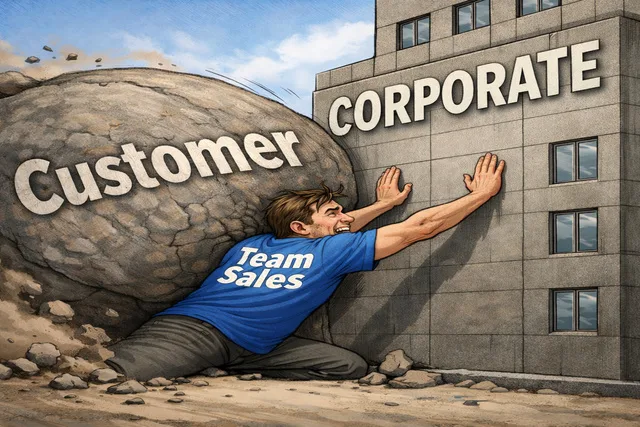
Between a rock and a hard place
I have been in sales roles twice in my career. Both experiences have helped me become very empathetic and supportive of those who provide revenue, and in turn employment, for the rest of us.
My second tour of sales duty was the most eye-opening as it made me reflect and ask, “When I was in prior corporate roles (i.e., not sales), was I one of those ‘sales preventers’ because the customer’s needs did not fit our product/service offering, policies, and/or processes?”
Sales professionals know that customers are demanding. What caught me off guard was that my employer was also very demanding. This set up potential conflict with what the customer needed and often was willing to pay for. I am not referring to the administrative burdens companies put on their sales team – I am thinking of resistance to new and growing customer requests versus the company’s desire to sell and leverage what they already make efficiently, profitably, with low/no risk. The reward for good work is more work, but often not just more of the same work.
Companies appropriately need to establish policies, procedures, etc., for efficiency and consistency. However, companies also need to have a fast review and approval process for customer exceptions that strategically make sense. The temptation is the low-risk (and low-reward and slow-death) path of telling your salesperson and your customer, “No exceptions, but here is a small price discount!” to try to get the customer to buy more of what they are not asking for.
Yes, and I will need this…
Instead selling companies need to promote and enable creative thinking and processes around what we need to get to “yes.” For example, there are often windows of “no changes” allowed after a certain point in time for many good reasons – late changes mean breaking into schedules and work in process, which reduces efficiency and increases risks or errors for all customer orders impacted, just to name two.
But (almost) everything is negotiable and doable – it just takes more time and/or money.
Create a process that enables evaluating and quoting the “forbidden” change order versus just citing the “no changes beyond x” policy. Customers learn there are costs associated with nonstandard requests. No value is given when no value is perceived.
Most times, customers say “thanks, but no thanks – we will stay as is” because you were just their first stop in a value chain of other vendors – i.e., someone else can accommodate the change. Sometimes it helped the customer narrow their request to what they really needed versus what they just wanted -for free. Customers always appreciated us providing options versus hiding behind policy.
A quick story to illustrate
In the early years of the growing requirements for sustainability, customers were increasingly wanting more product components to be “greener.” But the new “green” versions often did not offer economies of scale, so pricing was at a premium, plus the added cost of products needing to be tested. Our company sold a product that supplied multiple customers, but no one wanted to be the first and pay the premium. The pressure and mutual frustration grew year after year.
Finally, we flipped the script and told the customers that in two years, this product was going green but without a price increase, and the long advance notice was to give them time to get their products tested or find another vendor. My recollection is that every customer agreed, and we all had a great sustainability win to promote. I am embarrassed to admit it took almost two years before we produced that win-win solution.
One final thought about our beloved sales personnel
We tell them to do whatever it takes to get business – build relationships, avoid purchasing, RFPs are just suggestions, “break all the customer’s sourcing rules” if you will. But dear salesperson, you had better follow all our company rules! Fill out your expense reports correctly and on time, enter data ad nauseam into the antiquated CRM tool, and forecast in detail and accurately so we can constantly ask you to reconcile your newest forecast to the last forecast, and the list goes on, and on, and on.
Please do not be that small-minded for your “rainmakers.”
This blog was written without AI assistance other than MS Editor and edits from Katherine Nyboer https://www.linkedin.com/in/katherinenyboer/. The image is AI generated.